






















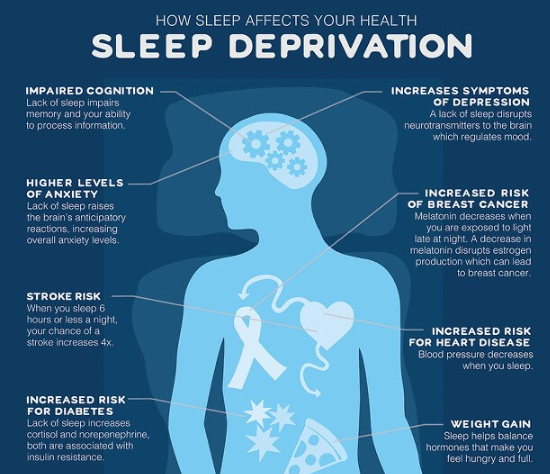
According to Thomas Dekker, “Sleep is like the golden chain that binds our health and body together.” According to a 2006 National Sleep Foundation poll, the organization had a recent survey of teen sleep that showed more than 87 percent of high school students in the United States get far less than the recommended eight to 10 hours. As this occurs, adolescents do not realize that sleep deprivation is affecting their ability to concentrate, impacting their grades, and causing anxiety/depression.
To start, Stanford Medical research professor, Ruthann Richter, first talks about how teenagers are facing sleep deprivation in school. For instance, Richter states, “Carolyn Walworth, 17, often reaches a breaking point around 11 p.m., when she collapses in tears. For 10 minutes or so, she just sits at her desk and cries, overwhelmed by unrelenting school demands. She is desperately tired and longs for sleep. But she knows she must move through it, because more assignments in physics, calculus, or French await her. She finally crawls into bed around midnight or 12:30 a.m. The next morning, she fights to stay awake in her first-period U.S. history class, which begins at 8:15. She is unable to focus on what’s being taught, and her mind drifts.”
As Richter states that teens like Carolyn fight to stay awake in class due to lack of sleep, it is clear that the human body starts to become more anxious because they are in a constant state of tiredness. The anxiety is also caused by the constant cycle of not being able to stay awake in class because you were up late doing homework, which will repeat the following day because of lack of sleep.
To add on to this, according to the UCLA Center for Developing Adolescents, teens who get a minimal amount of sleep are directly affecting their brain functioning negatively. For example, the UCLA Center for Developing Adolescents states, “Changes in the adolescent brain associated with puberty and maturation push adolescents’ circadian rhythm toward a ‘night owl’ preference of up to two hours later than in elementary school and slow the buildup of sleep pressure that makes us more and more tired as the day progresses.”
This evidence suggests that adolescents who get less than 8-10 hours of sleep show changes in brain chemicals that create a sense of tiredness as their day progresses. Not only does this significantly harm the development of their brains, but it also harms their early development in primary and secondary school.
Thirdly, in an article by the University of Florida pediatric specialist, Anne-Marie Slinger-Constant, she explains how adolescents are less likely to participate in school and have lower grades due to sleep deprivation. For instance, Slinger-Constant states, “Sleep deprivation can have a pretty significant effect on concentration, memory, and even mood,” she said. “If a child is chronically sleep deprived, it’s far more difficult for them to participate in classroom activities and learn new things. If they are tired, they won’t be engaged.”
In this piece of evidence, Slinger-Constant demonstrates how young adults are finding it harder to retain information and engage in class due to getting less than 8 hours of sleep. Not only does she prove participation will decline, but she also leads a process that shows grades will be lower due to children not actively participating in class.
To conclude, the UCLA Center for Developing Adolescents, Richter, and Slinger-Constant all demonstrate how important it is for a young adult to get 8 or more hours of sleep. Not only does the lack of sleep cause decreased concentration and poor grades, but it can also lead to anxiety/depression. Together, a human can reform their lifestyle by sufficiently getting 8 or more hours of sleep, which will ultimately be a “golden chain that binds the health and body together.”